
Wayne County Traffic Warrant Instructions in the Citation PDF
Wayne County Justice Court citations follow a local route. The county's citation and court-fees PDF spells it out. Contact the clerk within 14 days. You can pay or contest, and a hearing may be held in person or by Webex. Some violations require a mandatory appearance. The warning and bail additions in that document are tied to it, not a universal schedule for every criminal warrant.
Payment options in the PDF cover three routes. Pay online through the Utah Courts system, mail a check or money order to PO Box 327, Loa, Utah 84747, or pay in person where Wayne County allows it. Confirm the current total and any appearance rule first.
Wayne County Warrant Checks
For a first public check, use the Utah Statewide Warrants file linked from the Bureau of Criminal Identification, Utah's free public entry point. It searches statewide, not a Wayne County-only list. The public form asks for a first and last name, an optional middle initial, and a CAPTCHA. There is no county, court, date, or warrant-type filter. Start from the court on the notice. Wayne County Justice Court takes most traffic, infraction, and class B or C misdemeanor matters that fill local dockets. Felony and class A cases belong to the Sixth District Court. Custody or service questions can go to the Sheriff's main office. The staff will route the call.
- Use BCI for a preliminary statewide search using your own name.
- Use Utah Courts Xchange when you have a case or citation number.
- Call the issuing clerk to confirm the exact status and next step.
- Call the Sheriff only for service or custody routing.
- Keep a receipt, notice, or court order and confirm when status changes.
Wayne County BCI Warrant Search Is Statewide, Not Local
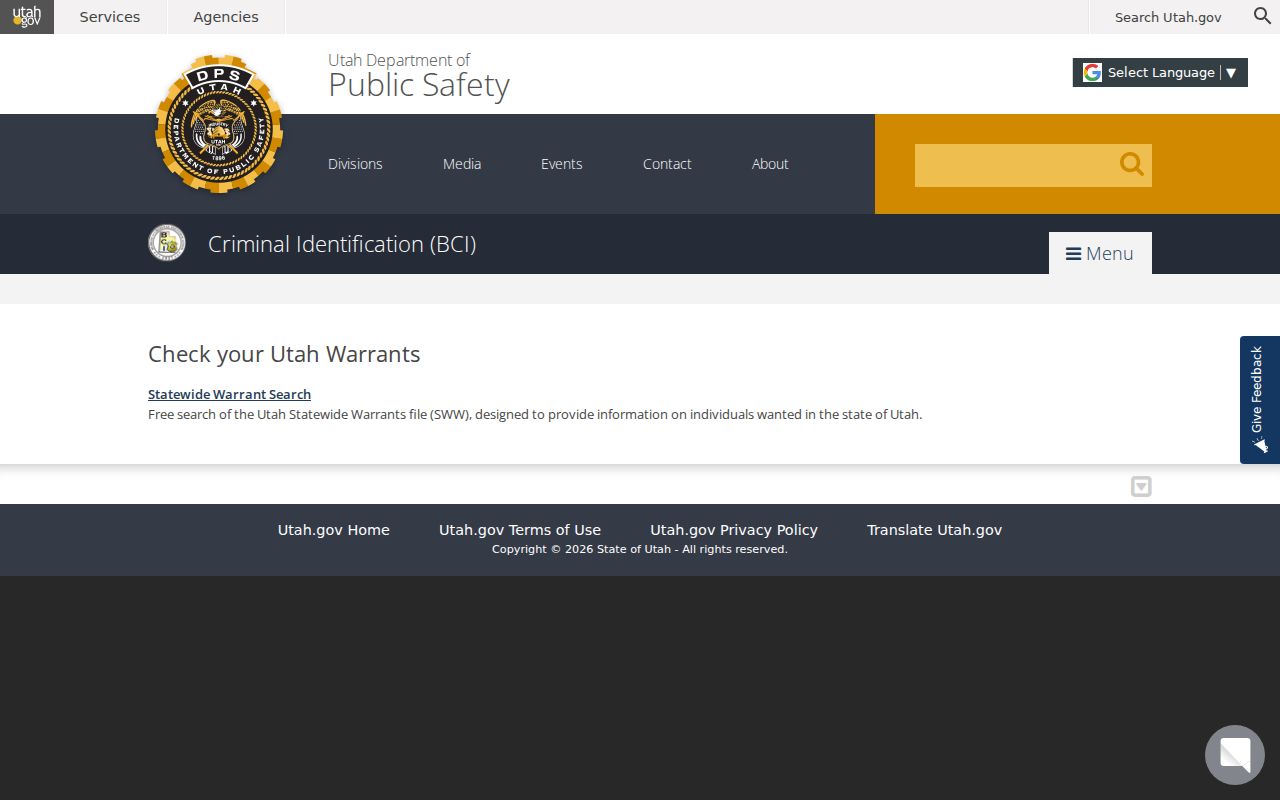
The BCI warrant page links to a free Utah Statewide Warrants search. Courts feed the system through electronic reporting. BCI cautions that accuracy and timeliness depend on courts entering and removing records promptly. No refresh schedule is published. Wayne County posts no local warrant count either. A result is a lead for court confirmation, since only the issuing court can settle current status. An empty search proves little. It means no public match came back, not that every court has cleared the matter. The official BCI page shows the entry route to the statewide search, an interface reference rather than a record about any person.
For a case-specific answer in Wayne County, check only your own record or help a relative with permission. Then call the issuing court.
Warrants in Wayne County: The Main Types
One word covers several court actions in Wayne County. Arrest warrants, bench warrants for missed appearances or unpaid fines, and traffic failure-to-appear warrants all show up in local practice. Juvenile matters carry separate access limits. A search warrant authorizes a search for evidence rather than an arrest, and the exact label on the court record controls.
| Record type | Common trigger | Wayne route |
|---|---|---|
| Arrest warrant | Probable-cause review and a judge’s decision to issue a warrant rather than a summons | Issuing court; peace officer named for service |
| Bench or FTA warrant | Missed appearance or failure to comply with a court requirement | Clerk of the court that set the matter |
| Traffic citation warrant | Missed date or payment obligation, subject to citation rules | Wayne County Justice Court when named on the citation |
| Juvenile warrant | Juvenile-court process | Sixth District Juvenile Court; special access rules apply |
Wayne County Warrant Questions Start at the Loa Courthouse
Wayne County's official county and court pages put both the Justice Court and the Sixth District Court in the Loa courthouse at 18 South Main. They share a building, not a docket. Each court keeps its own case files. Start with the court named on your notice. The Justice Court is the first local call for most traffic, infraction, and class B or C questions, while felony and class A matters go to the District Court instead.
Wayne County Warrant Records: What They Show
Public systems each show a different slice. BCI is name-based and statewide. Xchange summarizes cases from the court side. The court's own docket and clerk can explain the warrant label, release terms, next hearing, and update status. No sample schema is a live Wayne County warrant, and not every field is public.
| Name fields | BCI requires first and last name and allows an optional middle initial. The public form does not confirm a date-of-birth field. |
|---|---|
| Case or citation number | Use the number printed on the reader’s own notice to narrow Xchange or a clerk inquiry. |
| Issuing court | Confirm whether the entry belongs to Justice Court, Sixth District Court, or Juvenile Court. |
| Charge and warrant label | Read the court record or ask the clerk; a search result may not explain the full case. |
| Status and release terms | Ask the issuing court whether the warrant is active, recalled, served, or subject to a hearing. |
A No-Result Wayne County Warrant Search Still Needs Confirmation
Three problems can leave a Wayne County warrant search empty. The court may not have entered or removed an item yet, the record may be restricted, or the reader may have the wrong court or a common name. BCI's public page warns about its dependence on court reporting. Xchange also blocks public access to sealed, expunged, and juvenile cases. If a notice exists, keep it. Call the named clerk anyway. Wayne's rural layout matters too. Wayne County's official page describes about 2,475 square miles, with the courts and Sheriff based in Loa. A call first can save a trip for a question that belongs to another clerk or needs a specific appearance.
Wayne County Warrants: Who Issues, Who Serves
Under Utah law, a judge or magistrate issues a warrant. A peace officer serves it, and the warrant can name the responsible agency. The Wayne County Sheriff lists 435-836-1308, with the office at 18 South Main Street, Loa, UT 84747. No separate warrant phone or warrant window exists. There is no public service assignment chart either. Ask which agency the specific court record names. The county history page describes Wayne County's courthouse offices and Loa's county-seat role. Town administration is separate: Loa Town & Waterworks lists its own office at 80 West Center, not a warrant desk. The county page gives courthouse and office context only. It names no executing officer for an individual warrant.
In Wayne County, ask the named agency about service and the issuing court about dockets, recall, and payments.
One Missed Wayne County Citation May Become a Warrant
A Wayne County citation you let slide may have grown into a warrant. Keep the notice. Then call the Justice Court clerk with real questions. Can the violation simply be paid, or does it demand a hearing? What is the current amount? Did the court issue a warrant, and would a personal appearance or a judge's order be required? The county PDF explains payment and warning steps. It is not a live warrant lookup, though. Payment, a new court date, release, and dismissal are all different outcomes, so follow whatever the clerk tells you and ask which one applies. Afterward, keep the receipt or order and ask when the court record and the statewide file should show the change. If the matter sits in District Court instead, work through that clerk rather than the Justice Court traffic process.
Handling a Wayne County Warrant
Start by naming the issuing court. Ask what the Wayne County warrant actually requires. A Justice Court citation may still allow payment. A mandatory-appearance offense, or a warrant issued later, can force a court date or another step. For a District Court warrant, check with the clerk or an attorney about the approved route before you show up. The county publishes no general surrender window and no countywide criminal bond schedule.
Before acting: Confirm the current release condition with the issuing court or counsel. No source promises that a voluntary appearance avoids arrest or ends the underlying case.
Helping a relative? Permission and access rules still apply. Family ties alone do not open restricted records in Wayne County. Do not treat a third-party result, a town-office answer, or an empty statewide search as a substitute for the court's own instructions.
What Wayne County Warrant Sources Do Not Establish
Wayne County itself posts no active-warrant list, no most-wanted roster, and no amnesty event. It runs no warrant phone line, posts no jail bond counter hours, and Loa, Bicknell, Torrey, Lyman, and Hanksville each list no city warrant portal. A town citation still belongs to the court named on it, not necessarily the county. And a clean BCI or Xchange result does not prove no warrant exists anywhere. For a copy of an existing public record, a narrow Utah Government Records Access and Management Act (GRAMA) request can go to the agency that holds it. GRAMA never forces an office to build a new roster. Courts may also use their own records process, so ask the holder first.
Warrant Record Access Under Utah Law
Utah Code §63G-2-201 makes records public unless another law, rule, or court order restricts them. Restricted classifications and court rules still apply in Wayne County. Utah Code §78A-6-209 gives juvenile records separate protections. Sealed or expunged records are not ordinary public search material. Send a focused request to the actual record holder rather than asking for a new countywide list.
Access rules:
Utah Code §63G-2-201 sets the public-record baseline, subject to exceptions.
Utah Code §78A-6-209 sets special juvenile-record inspection rules.
Utah Code §53-10-208 describes the statewide warrant file and the court-fed records process.
Wayne County Towns and Their Warrant Starting Points
Wayne County's five incorporated towns have different civic sources. Each still turns on the same task: identify the court named on the notice. Loa holds the county-seat courthouse. Bicknell has a public-body listing. Torrey's General Plan describes county and state public-safety coordination, while Lyman has a county-listed town hall and Hanksville publishes town-office hours. None of that creates a city warrant database or a municipal court. Use a town office for civic routing, and use the court for case status.
Loa Warrants
516 residents in 2020; county-seat courthouse and separate town office.
Bicknell Warrants
323 residents in 2020; official town-council listing, no warrant interface located.
Torrey Warrants
231 residents in 2020; public-safety structure described as county and state based.
Lyman Warrants
196 residents in 2020; county location listing gives a town-hall address.
Hanksville Warrants
158 residents in 2020; town site lists local office hours and contact details.